
 English
  Deutsch
 Français
 Русский
 Español
 Português (Brasil)
 Bahasa Melayu
 Bahasa Indonesia
 한국어
한국어 Nederlands
 Tiếng Việt
 العربية
From Product Idea to Cosmetic Formula: What Happens During Formulation Development?
From Product Idea to Cosmetic Formula: What Happens During Formulation Development?
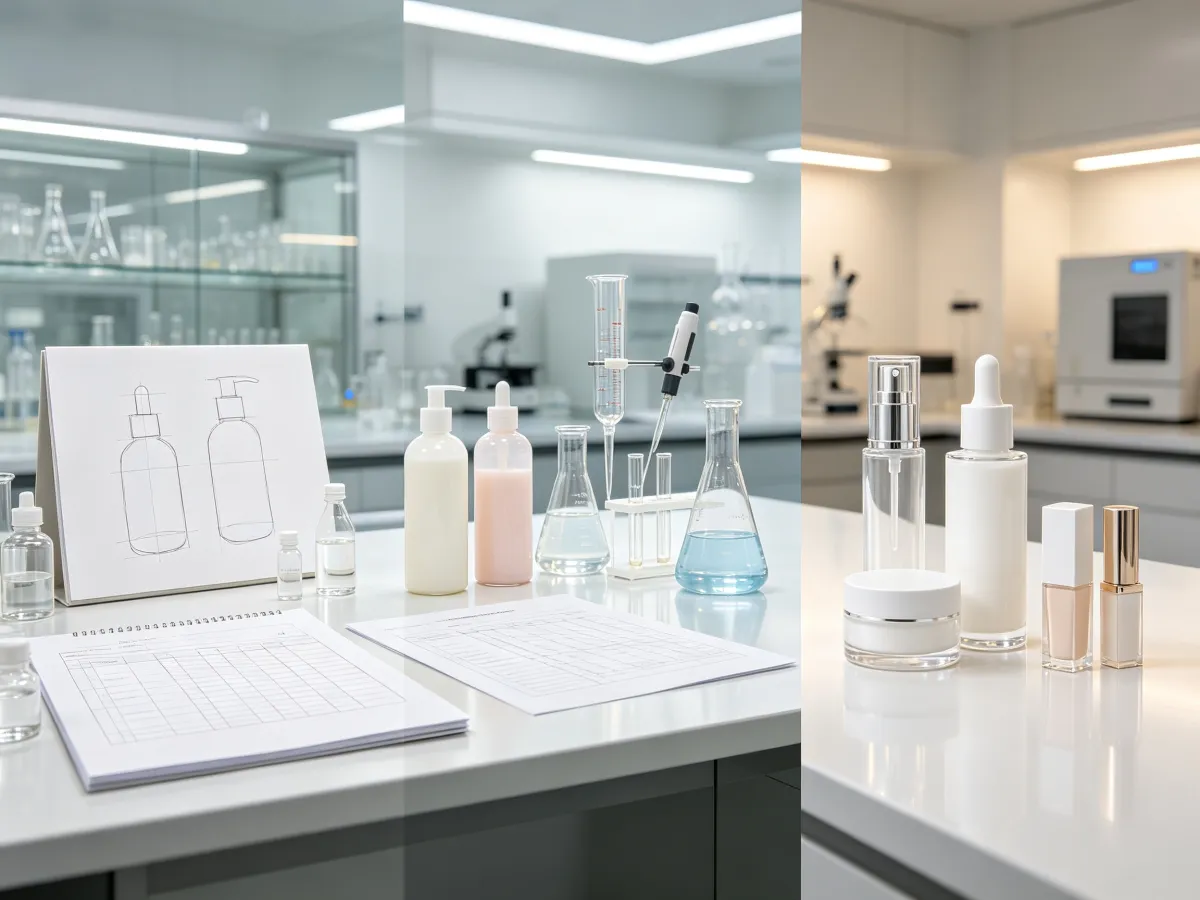
A new cosmetic product often starts with a simple idea.
A brand may want to develop a lightweight serum, a refreshing facial mist, a rich body cream or a gentle cleanser.
But turning that idea into a real cosmetic product requires much more than writing a product name and selecting a few ingredients.
The formulation development process is where the product concept begins to become something that can actually be sampled, evaluated, refined and eventually manufactured.
For brands that have never developed a cosmetic product before, understanding this process can make communication with a formulation team much easier.
Step 1: Define the Product Concept
Before a formulation is created, the product itself needs to be defined.
Useful information includes:
Product type
Target consumer
Intended market
Main product purpose
Desired texture
Fragrance preference
Packaging format
Expected product positioning
For example, saying:
“We want a skincare product for young consumers.”
is quite broad.
A more useful development brief might describe:
“A lightweight daily facial moisturizer designed for consumers who prefer a fresh, fast-absorbing texture.”
The second description gives the formulation team a clearer direction.
Step 2: Understand the Target Consumer
A product should be developed for someone.
Different consumers can have different expectations regarding texture, fragrance, packaging and product format.
Climate can also matter.
A product intended for a warm and humid market may require a different sensory direction from one intended for a colder environment.
Understanding the consumer helps determine what kind of product experience should be developed.
Step 3: Choose the Product Format
The same concept can sometimes be developed in different formats.
For example, a hydration-focused product might become a toner, serum, gel cream, lotion or mask.
Each format has its own formulation considerations.
The choice should depend on how the product is expected to be used and what kind of experience the brand wants to create.
Choosing the format early can make the formulation process more focused.
Step 4: Develop the Formula Direction
Once the product concept is clear, formulation work can begin.
This may involve selecting appropriate ingredient categories and determining how they can work together.
The formulation team may consider:
Desired texture
Ingredient compatibility
pH
Viscosity
Stability
Sensory properties
Preservation
Packaging compatibility
This is where the difference between a product concept and a real formula becomes clear.
A concept may sound simple, but creating a formula that performs consistently can require considerable development work.
Step 5: Create the First Sample
The first sample is an important milestone.
However, it should not always be treated as the final product.
A first sample allows the brand to evaluate whether the formulation is moving in the intended direction.
The brand may discover that:
The texture is too heavy
The product absorbs too slowly
The fragrance is too strong
The product needs more slip
The viscosity is not suitable
The packaging does not dispense it well
These findings are useful.
They give the formulation team information for the next adjustment.
Step 6: Evaluate the Sensory Experience
Sensory evaluation is an important part of skincare development.
A brand can consider:
Before application:
How does the product look and smell?
During application:
How easily does it spread?
Immediately after application:
Does it feel sticky, oily, smooth or comfortable?
After absorption:
What kind of after-feel remains?
These details can have a significant influence on consumer acceptance.
A formula can meet its technical requirements and still need sensory improvement.
Step 7: Adjust the Formula
Formula development is often an iterative process.
The first sample may lead to several rounds of adjustment.
This is normal.
For example, if a serum feels too sticky, the formulation team may investigate which components are contributing to that sensation and adjust the overall formula.
If a cream feels too heavy, the team may work on the balance of emollients, oils, thickeners and other components.
The goal is to move gradually toward the desired product experience.
Step 8: Consider the Packaging
Packaging should not be treated as an afterthought.
The package needs to match the product.
A very fluid serum may require a suitable dispensing system.
A thick cream may need a different solution.
The package also needs to support the intended user experience and protect the product appropriately.
For international products, transportation and storage considerations may also be relevant.
Step 9: Evaluate Stability and Quality
Once the formulation is closer to the intended version, additional testing and evaluation can become important.
Depending on the product, this can include assessment of:
Appearance
Color
Odor
pH
Viscosity
Stability
Packaging compatibility
Microbiological quality
The exact testing program depends on the formulation and product requirements.
The purpose is to understand whether the product can remain consistent under appropriate conditions.
Step 10: Prepare for Manufacturing
A formula that works well in a laboratory or development environment still needs to be suitable for production.
Scaling up can introduce new considerations.
Mixing equipment, processing conditions, production sequence and batch size can all influence the manufacturing process.
This is why formulation development and manufacturing should not be viewed as completely separate stages.
A practical formula needs to be reproducible.
What Information Should a Brand Prepare?
If you are contacting a cosmetic manufacturer or formulation team for the first time, having a clear product brief can save time.
You can prepare:
Product type:
Serum, cream, cleanser, toner, mask, etc.
Target consumer:
Who will use the product?
Target market:
Which country or region?
Desired texture:
Lightweight, rich, gel-like, creamy, fast-absorbing, etc.
Product positioning:
Mass market, premium, professional, natural-inspired, or another direction.
Packaging idea:
Bottle, tube, jar, pump, spray, etc.
Reference products:
Products whose texture or experience you like.
The more clearly these points are described, the easier it becomes for a formulation team to understand the intended direction.
FAQ
How many samples are usually needed before a formula is finalized?
There is no universal number. It depends on the complexity of the product, the initial formula and the amount of adjustment required.
Can a brand provide an existing product as a reference?
Yes. A reference product can be useful for communicating desired texture, appearance and sensory experience.
Does the formula have to be finalized before packaging is selected?
Not necessarily. Formula and packaging are often developed alongside each other because compatibility and dispensing can affect the final product.
Can a formula be customized?
Yes, depending on the product requirements, formulation feasibility, ingredients, target market and other development considerations.
Is the first sample the final formula?
Usually, a first sample should be considered a development stage rather than automatically the finished product.
From an Idea to a Real Product
The distance between a product idea and a finished cosmetic can be much greater than it first appears.
A good formulation process connects the original concept with the practical requirements of the final product.
The process can be summarized as:
Concept → Product Brief → Formulation → Sample → Evaluation → Adjustment → Testing → Manufacturing
For brands, the most useful approach is to communicate the desired product experience as clearly as possible while remaining open to formulation adjustments.
Sometimes the original idea needs to change slightly once the formulation team begins working with the ingredients.
That is not necessarily a problem.
Product development is often a process of finding the best balance between concept, formula, sensory experience, packaging, stability and manufacturability.
The final goal is not simply to create a formula containing certain ingredients.
It is to create a cosmetic product that makes sense for its intended consumer and market.