
 English
  Deutsch
 Français
 Русский
 Español
 Português (Brasil)
 Bahasa Melayu
 Bahasa Indonesia
 한국어
한국어 Nederlands
 Tiếng Việt
 العربية
A Great Formula Deserves Great Manufacturing
Developing a successful cosmetic formula is an important achievement, but it is only one part of creating a finished product.
The next challenge is turning that formula into a consistent, reliable and market-ready cosmetic product.
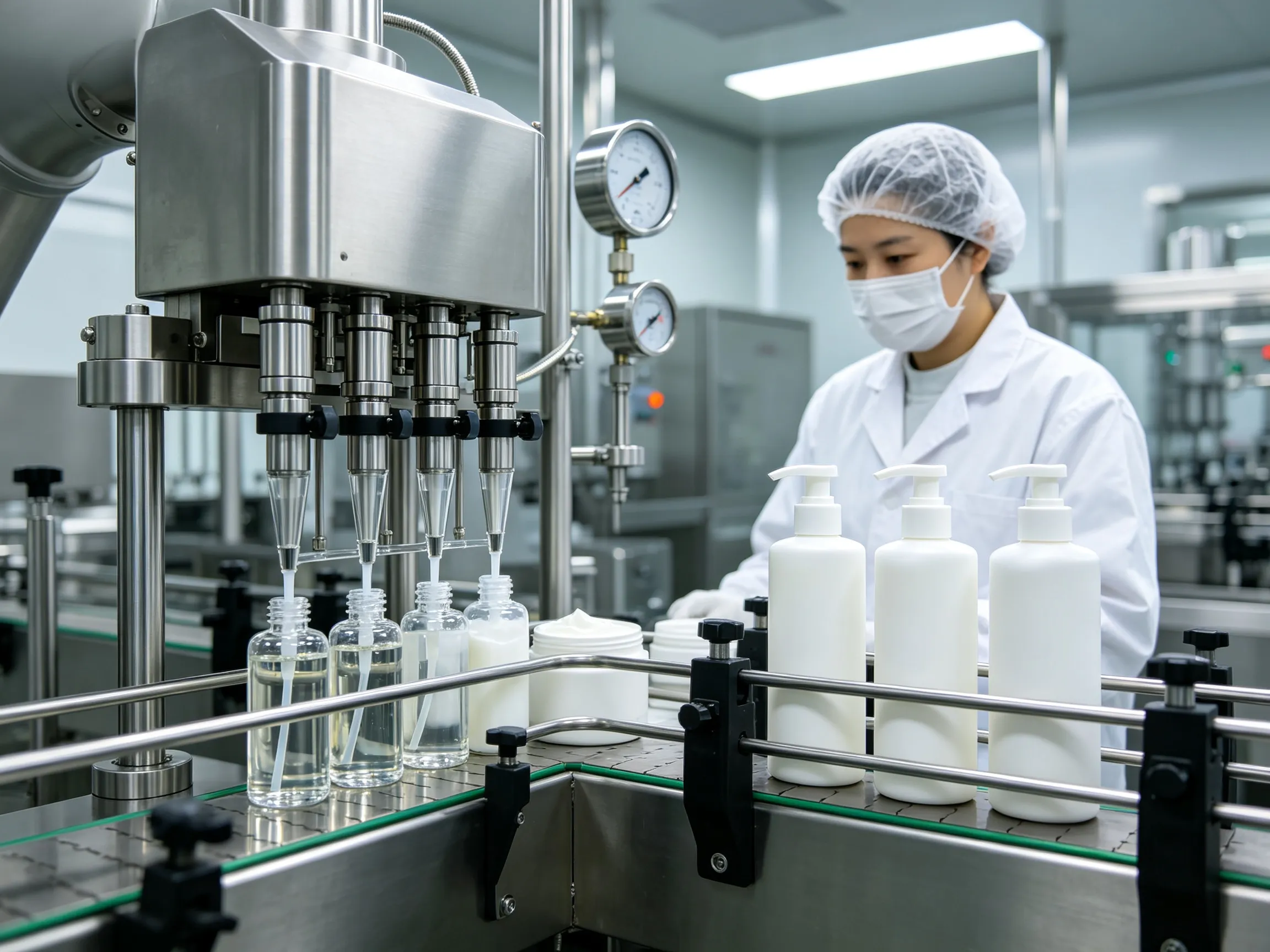
A laboratory sample may look perfect in a small container, but commercial production introduces an entirely different set of requirements. Mixing, emulsification, processing, filling, packaging, quality control and batch consistency all become important when a product moves from development into manufacturing.
At SGBIOLAB, we connect product development with manufacturing so that your formula can move toward real-world production.
From skincare and haircare to body care and personal care products, our manufacturing capabilities are designed to support a wide range of cosmetic products and formats.
The objective is not simply to manufacture one batch.
It is to create a repeatable production process that can support your product as your brand grows.
From Formula to Finished Product
The journey from a formulation laboratory to a finished cosmetic product involves many stages.
A simplified process may look like:
Formula Development → Sample Evaluation → Production Preparation → Manufacturing → Filling → Packaging → Quality Control → Finished Product
Each stage contributes to the final result.
A formula needs to be translated into an appropriate manufacturing process. Raw materials need to be prepared and handled correctly. Production parameters need to be controlled. Filling and packaging need to match the product format.
The finished product then needs to meet the required quality standards before it is prepared for delivery.
This is why cosmetic manufacturing is much more than operating a filling machine.
It is a complete production system.
Manufacturing a Wide Range of Cosmetic Products
The beauty industry includes an enormous variety of products.
Our manufacturing capabilities are designed to accommodate a broad range of cosmetic applications, including:
Skincare
Serums, creams, lotions, cleansers, toners, masks, moisturizers and other facial and skincare products.
Haircare
Shampoos, conditioners, hair masks, hair treatments and scalp care products.
Body Care
Body lotions, body creams, body washes, scrubs and hand care products.
Personal Care
A broad range of everyday personal care products can be developed and manufactured according to the product concept and intended application.
Different Product Formats
Depending on the product, manufacturing and filling can involve bottles, jars, tubes, pumps, droppers and other packaging formats.
This broad product capability gives brands more freedom when developing or expanding a product range.
You do not need to build your own production system for every new product.
Instead, you can work with a manufacturing partner capable of supporting different product concepts.
Manufacturing Starts Before the Production Line
Good production begins before the machines are switched on.
Once a formula is ready for manufacturing, the production team needs to understand the product requirements and determine how the formula can be processed appropriately.
Different products can require different processing approaches.
A cream may require emulsification.
A serum may require a different mixing process.
A shampoo has different production characteristics from a facial cream.
A body lotion may require different processing and filling considerations.
The manufacturing process therefore needs to be aligned with the characteristics of the product.
This connection between formulation and production is important because a formula should ultimately be designed not only to perform well in the laboratory, but also to work as a commercial product.
Controlled Cosmetic Manufacturing
Consistency is one of the most important requirements in cosmetic manufacturing.
Customers expect the product they purchase today to have the same fundamental characteristics as the product they purchased previously.
For a brand, consistency is equally important.
If the appearance, texture, fragrance or other characteristics of a product change significantly between batches, customer confidence can be affected.
That is why production control matters.
Manufacturing involves managing raw materials, production procedures, processing conditions and quality checks throughout the production cycle.
The goal is to create a controlled process that can repeatedly produce the intended product characteristics.
From Raw Materials to Bulk Product
Before filling begins, the cosmetic formula must first be produced as a bulk product.
This stage involves bringing the required raw materials together according to the established formulation and manufacturing process.
Depending on the product, the process may involve:
Material preparation
Mixing
Dissolution
Emulsification
Homogenization
Temperature control
Cooling
Adjustment
Bulk inspection
The exact process depends on the product.
A skincare cream, a facial serum and a shampoo may require very different processing considerations.
The purpose is always the same:
Create a stable and consistent bulk product that is ready for the next stage of manufacturing.
Filling and Packaging
Once the bulk product has been prepared and approved for the next stage, filling becomes the bridge between manufacturing and the finished product.
Packaging is more than a visual element.
The container must be appropriate for the product format and intended use.
Depending on the product, packaging may include:
Bottles
Jars
Tubes
Pumps
Droppers
Other cosmetic containers
The filling process also needs to maintain consistency from unit to unit.
For brands, this is where the product begins to look like the final product customers will see on shelves, websites and social media.
It is the point where formulation, manufacturing and packaging finally come together.
Quality Control Throughout Production
Quality should not be treated as something that happens only at the end.
A more reliable approach is to consider quality throughout the manufacturing process.
Depending on the product and requirements, quality control may involve different stages of inspection and evaluation.
Raw Material Control
Materials used in production need to meet the required specifications before being introduced into the manufacturing process.
In-Process Control
Production can be monitored at appropriate stages to help maintain consistency and identify potential issues.
Bulk Product Evaluation
Before filling, the bulk product can be evaluated according to relevant characteristics and requirements.
Finished Product Inspection
Finished products can be checked to ensure that they meet the established requirements before shipment.
This approach creates multiple opportunities to identify and address issues rather than relying entirely on one final inspection.
Batch Consistency Matters
For an emerging beauty brand, the first production run can feel like the most important milestone.
But the second, third and tenth production runs are just as important.
A successful product should be capable of maintaining its essential characteristics as production continues.
This is why repeatability is a critical part of cosmetic manufacturing.
A manufacturing partner should not simply ask:
Can we make this product?
A better question is:
Can we make this product consistently?
That difference becomes increasingly important as a brand grows.
When demand increases, production needs to scale while maintaining the characteristics that customers already know and trust.
Manufacturing for Growing Beauty Brands
Different brands are at different stages.
A new beauty company may be developing its first product.
An established brand may be adding a new serum to an existing skincare line.
Another company may be expanding from skincare into haircare or body care.
A growing business may need a broader product portfolio without investing heavily in its own manufacturing infrastructure.
A flexible manufacturing partner can provide an important advantage in each situation.
Instead of treating every project as identical, production can be considered around the specific product, packaging and business requirements.
Packaging Is Part of the Product
The formulation may be the heart of a cosmetic product, but packaging is how consumers interact with it physically.
The right packaging should complement the product.
A serum may be presented in a dropper bottle.
A cream may use a jar.
A lotion may use a pump.
A hair product may require a different container altogether.
Packaging also influences the visual identity of a beauty brand.
This is why manufacturing support should consider the finished product as a whole rather than treating the formula and packaging as completely separate projects.
From Product Concept to Finished Cosmetic
The strongest manufacturing projects are built around communication.
The more clearly the product requirements are understood, the easier it becomes to align formulation, production, packaging and quality expectations.
A project may begin with a simple request:
"I want to develop a hydrating serum."
But the finished product may require much more detail:
What type of texture?
What kind of skin feel?
Which ingredients?
What packaging?
What market?
What positioning?
What production requirements?
What quality expectations?
Each decision contributes to the final product.
Our role is to help connect these decisions into a practical manufacturing process.
A Manufacturing Partner for More Than One Product
One of the biggest advantages of working with a manufacturer capable of handling a broad range of cosmetics is flexibility.
Your first product may be a facial serum.
Your second may be a moisturizer.
Your third could be a shampoo.
Later, you may want to develop a body lotion, hair treatment or another specialized product.
The ability to work across different cosmetic categories makes it easier to build a complete product portfolio around your brand.
Instead of starting from zero with every new product, you can develop a longer-term manufacturing relationship.
Quality, Consistency and Market Readiness
A finished cosmetic product needs to be more than visually attractive.
It needs to be manufactured through a controlled process, packaged appropriately and prepared according to the relevant quality and compliance requirements for its intended market.
For international brands, this becomes particularly important.
Different markets may have different regulatory, documentation and labeling requirements.
That is why market readiness should be considered throughout product development and manufacturing rather than only immediately before shipment.
A professional manufacturing process helps create a stronger foundation for this final stage.
Built to Support the Complete Product Journey
The journey from a cosmetic idea to a finished product can involve many decisions.
Formula.
Ingredients.
Texture.
Testing.
Production.
Filling.
Packaging.
Quality.
Delivery.
Working with disconnected suppliers for every stage can make the process more complicated.
An integrated development and manufacturing partner can help simplify that journey.
At SGBIOLAB, our goal is to connect these stages so that your product can move from concept to finished cosmetic through a more coordinated process.
Your Formula Is Ready. What's Next?
Perhaps you already have a finished formula.
Perhaps you have developed a successful sample and are now looking for a production partner.
Or perhaps you are still developing the product and want manufacturing considerations to be part of the process from the beginning.
Whatever stage you are at, the next step is to understand what your product requires.
Our team can work with your product information and development requirements to explore the appropriate path toward production.
The goal is not simply to fill containers.
The goal is to manufacture a product that your brand can confidently put into the market.
From Laboratory to Market
A successful cosmetic product is the result of many stages working together.
A strong formula creates the foundation.
Good manufacturing turns that formula into a consistent product.
Appropriate filling and packaging create the finished presentation.
Quality control helps protect consistency.
And ultimately, the finished product reaches the consumer.
That is the complete journey.
At SGBIOLAB, we are equipped to support a broad range of cosmetic product development and manufacturing needs, from skincare and haircare to body care and personal care.
Whether you are creating your first product or expanding an established beauty portfolio, we are ready to explore what can be built together.
Let's Turn Your Formula Into a Finished Product
Tell us what you are developing, what you already have and what you need next. Our team can help you explore the path from formulation to production, filling, packaging and a market-ready cosmetic product.